


What are seller concessions? A Pittsburgh buyer's guide to seller's assist
Seller concessions, which most Pittsburgh agents call seller's assist, are one of the best ways to make buying a home affordable. The problem is that a lot of agents don't understand the math and loan rules behind them well enough to use them, much less explain them.
Here's a simple guide to how seller concessions work, how much you can ask for with each type of loan, and how to structure an offer so the money actually shows up at closing.
What is a seller concession?
A seller concession is money the seller agrees to credit you at closing to pay your closing costs. You'll also hear it called seller's assist, a seller credit, or seller-paid closing costs. Lenders call it an interested party contribution. It's all the same thing.
Seller's assist can pay for:
- Lender fees, like origination and underwriting
- Title insurance and settlement fees
- The appraisal
- Prepaid property taxes and homeowners insurance that go into your escrow account
- Discount points to lower your interest rate
It can't pay your down payment. Every major loan program requires your down payment to come from your own money or an approved gift.
Buy Down Your Rate With Seller Concessions
At the time of writing this, interest rates are 7.25%. You can do what is called a rate buy down, which lets you buy 0.25% interest rate discount for every 1% of the purchase price. To get a full 1% reduction, you'd need 4% which is possible to get. In fact, this is one of my current favorite negotiation strategies with my buyer clients, especially when a home is priced too high. That 1% reduction can be hundred(s) of dollars less a month in your payment plus major interest savings. On a $200K home, this could result in over a $100K in savings over 30 years between what you save in monthly payments and accrued interest. Check out our article on Rate Buy Downs because this one deserves its own, but a worthwhile mention here.
Is the seller really giving you money?
Let's highlight the word "give." Nine times out of ten, the seller isn't just handing you money. You add the concession to your offer price, and the seller credits it back to you at closing. You're still paying for it, but you're paying through your mortgage instead of out of your savings. It's a legal way to finance your closing costs.
Here's how that looks. Say you find a $200,000 home at the top of your budget and you're buying with an FHA loan. Your 3.5% down payment is $7,000, and your closing costs are around $10,000. You've saved $10,000 total, so you're short.
Instead of offering $200,000, you offer $210,000 and ask for $10,000 in seller's assist. The seller still nets $200,000. Your down payment goes up slightly to $7,350, but your closing costs are covered, so you can close with the cash you have.
The tradeoff is a loan that's about $9,650 bigger, which means a slightly higher monthly payment and interest on that amount over the life of the loan. For most buyers who are short on cash, that's a trade worth making.
What happens if the house doesn't appraise?
Your lender figures your loan and your concession limit using the lower of the purchase price or the appraised value. If that $210,000 house appraises at $200,000, the lender treats it as a $200,000 house. You'd have to renegotiate or bring the $10,000 difference to closing yourself.
Before you raise your offer to cover seller's assist, make sure recent sales in the neighborhood support the higher price.
Do you have to raise your offer to get seller's assist?
No, but that is usually how it works. The seller is not really giving you the money.
Sometimes it works better to leave the price alone in a case where the home may be overpriced rather than offering lower.
Say a home is listed at $200,000, and you were planning to offer $190,000. Instead, offer the full $200,000 and ask for $10,000 in seller's assist. The seller still gets their number, their asking price. That matters to sellers more than it probably should. You still get the home for a net $190,000, and you keep $10,000 in your pocket at closing.
Offering lower usually gets a worse reaction than this, because of psychology. The seller hears "full price." Just like the first example, the comps have to support the $200,000 price, because the appraisal still has to come in at the contract price. Also, $10K off the price isn't saving you much at all in a monthly payment or in interest over 30 years.
How much can a seller pay toward closing costs?
The amount of seller's assist you can get depends on your loan type, and with conventional loans, on how much you put down. The percentage is based on the lower of the purchase price or appraised value.
| Max seller concessions allowed | |||
|---|---|---|---|
| Loan type | Primary home | Second home | Rental home |
| Conventional loans: | 3% under 10% down 6% with 10%+ down 9% with 25%+ down | 3% under 10% down 6% with 10%+ down 9% with 25%+ down | 2% |
| Jumbo loans: | Set by lender | ||
| FHA loans: | 6% | Not available | |
| VA loans: | 4% plus normal closing costs | ||
| USDA loans: | 6% | ||
| Based on the lower of the purchase price or appraised value. Seller's assist can't exceed actual closing costs and can't pay the down payment. Updated October 2026. Sources: Fannie Mae B3-4.1-02, HUD 4000.1, VA and USDA guidelines. | |||
A few things to know about these limits:
- Conventional loans follow Fannie Mae and Freddie Mac rules. Put down less than 10% and you're capped at 3%. Put down 10% or more and it goes to 6%. Put down 25% or more and it's 9%. Investment properties are capped at 2% no matter what you put down.
- FHA loans allow up to 6%, no matter how much you put down.
- VA loans cap concessions at 4%, but the seller can pay your normal closing costs on top of that. The 4% covers extras, like prepaying your property taxes and insurance. That makes VA the most generous program for seller's assist.
- USDA loans allow up to 6%.
- Jumbo loans don't have a universal limit. Each lender sets its own.
No matter the loan type, the seller's assist can't be more than your actual closing costs.
This is why your loan type matters before you write an offer. Go back to the first example. On a conventional loan with 5% down, you'd be capped at 3% of $210,000, which is $6,300. Asking for $10,000 wouldn't work. On FHA, the cap is 6%, or $12,600, so the same offer works fine.
Can seller concessions be used for a down payment?
No. Seller's assist only pays closing costs and prepaid items. What it can do is free up the cash you would have spent on closing costs, so you can put it toward your down payment instead.
Can the seller pay your transfer tax in Pennsylvania in addition to seller's assist?
Yes, and it's negotiated in the agreement of sale. Pennsylvania charges a 1% state realty transfer tax, and most municipalities and school districts add their own, usually bringing the total to 2%. Some places are higher. The City of Pittsburgh is 5% total. You can look up any municipality on our Pennsylvania transfer tax page.
The Pennsylvania Agreement of Sale handles transfer tax in its own section, separate from seller's assist. Unless the agreement says otherwise, the buyer and seller split it 50/50, and there's a field to change that split. That gives you a second lever to pull when you need more help than your seller's assist cap allows.
Say you're using a conventional loan, you're capped at 3% seller's assist, and you really need 4%. Ask for 3% in seller's assist and ask the seller to pay the full transfer tax. In a municipality with a 2% transfer tax, that frees up 4% of your cash. On a $200,000 purchase, that's $8,000 toward closing costs you won't need to have in the bank.
Can you get cash back at closing with seller concessions?
No. If the seller's assist is more than your actual closing costs, you don't get the difference back as cash. The lender either reduces the credit, or you put the extra toward something allowed, like discount points to lower your interest rate.
Where I see this come up most is with buyers using a down payment assistance program. Down payment assistance isn't free money. Many programs come with a higher interest rate because you're not putting your own cash down. If you have extra seller's assist room, using it to buy that rate back down is one of the best things you can do with it.
The timing matters. Once your rate is locked, changing it can backfire, especially if rates have gone up since you locked. You can always increase your down payment after your formal loan application is submitted, but changing your interest rate is where it gets tricky. Plan for how you'll use any extra credit before you lock.
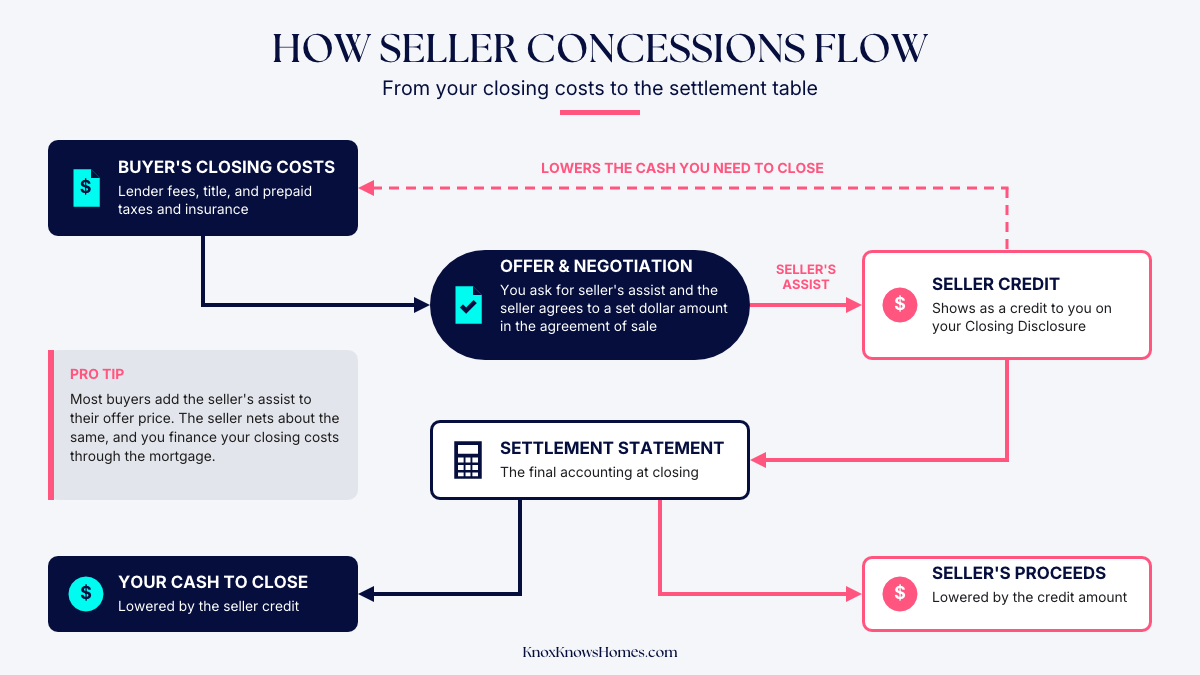
This workflow illustrates how seller concessions work on the closing ALTA statement.
Why your agent's closing cost estimate matters
Pennsylvania requires your agent to give you a written estimate of your closing costs before you sign an agreement of sale. That estimate is how you figure out how much seller's assist to ask for.
If your agent doesn't have a head for numbers, they probably won't catch the issues above. Most agents use a generic calculator that overestimates closing costs and doesn't give an accurate estimate. Many of these free tools don't know what to do with a negative number, so a seller credit doesn't show up in the totals. The itemized lines show the credit, but the bottom line ignores it. That bottom line is the number you're planning your money around.
Be careful who you use as an agent
This isn't a dig against agents. There are plenty of agents who are savvy about mortgages and closing costs. But many agents are brand new and still learning, and even among seasoned agents, you'd be amazed at how many don't understand these basics.
You need an agent with a sound strategy and knowledge of seller concessions, loan limits, and how offers are structured. I'm a Realtor and a licensed mortgage loan originator, so this is the math I work with every day.
How to ask for seller's assist the right way
- Know your loan type and down payment. Your limit depends on both, so get preapproved before you start writing offers.
- Get a real closing cost estimate. Ask for the number for that specific house, including your share of the local transfer tax.
- Check your cap. Make sure what you're asking for fits your loan's limit and doesn't exceed your actual closing costs.
- Pick your price strategy. Either add the assist to your offer or ask for it at the asking price. Either way, make sure the comps support the contract price.
- Plan for leftover credit before you lock your rate. If you'll have extra room, decide up front whether it goes toward discount points.
Other Types Of Seller Concessions
While seller concessions actually mean "assist" in the form of monetary credit from a seller, many agents have published technically wrong info that I'll list here. A concession by definition means someone concedes to a request. A seller may agree to provide a home warranty, for example. There is a monetary value to that, but it's not technically classified as a seller concession in your sales agreement in Pennsylvania. Here are other types of seller concessions that do not involve the seller giving you cash at closing:
- Home warranty
- Personal Property: Items not offers as inclusions upfront your agent negotiates into the deal that you ask for: furniture, home decor, etc.
- Repairs
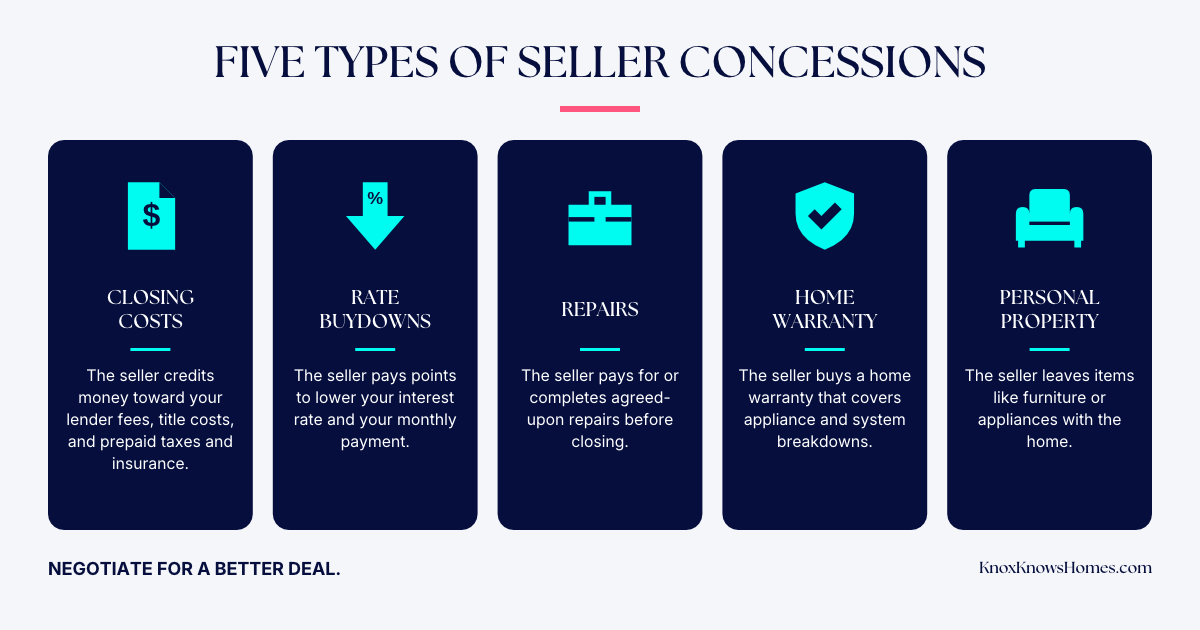
This graphic shows the 5 types of seller concessions: Closing costs, rate buy downs, repairs, home warranty, and personal property. Seller concessions typically mean cash the seller gives at closing, but all of these meet the definition of a concession.
The Knox Team, Home of Pittsburgh's Pawperty Pros. We rescue a shelter pet for every home sold.
Sources
- Fannie Mae Selling Guide B3-4.1-02, Interested Party Contributions
- HUD Handbook 4000.1 IPC section (Mortgagee Letter 16-11 attachment)
- Veterans United: VA closing costs vs. concessions
- Mortgage Research Center: USDA seller concessions
- FHFA letter confirming common and customary seller costs fall outside IPC limits
- Truist correspondent guide: transfer taxes excluded only when sellers customarily pay them
- 49 Pa. Code § 35.334, statements of estimated cost
- PAR: Estimated closing costs, how mandatory are they
- pa.tax: Pennsylvania realty transfer tax
- iBuyer.com: What is seller's assist (competitor with PA section)
Check out this article next