
Pittsburgh Home Seller & Buyer Resources
What Is Transfer Tax in Pennsylvania? A Pittsburgh Buyer and Seller Guide
Learn about what property transfer taxes are and what the rates are for all municipalities on Allegehenney County, Washington County, Beaver County, & Butler County.
Western Pennsylvania Transfer Tax Deviations By County & Municipality
Transfer Taxes in Pennsylvania are usually 2% (1% to the State and 1% to the municipality).
Some municipalities have higher local transfer taxes that deviate from the norm, and this is an important factor to consider when buying a home in the Greater Pittsburgh Area, as it adds significant costs.
The municipalities below deviate from the standard 1% local rate. Rates effective March 1, 2024. If your municipality is not listed, the standard 2% applies.
| County | Municipality | Local Rate | Total Transfer Tax |
|---|---|---|---|
| Allegheny | Bellvue Boro | 1.50% | 2.50% |
| Bethel Park | 1.50% | 2.50% | |
| Greentree Boro | 1.50% | 2.50% | |
| Hampton Twp. | 1.50% | 2.50% | |
| McCandless Twp. | 1.50% | 2.50% | |
| McKeesport City | 2.00% | 3.00% | |
| Monroeville | 1.50% | 2.50% | |
| Mt. Lebanon | 1.50% | 2.50% | |
| Mt. Oliver Boro | 2.00% | 3.00% | |
| O'Hara Twp. | 1.50% | 2.50% | |
| Penn Hills | 2.00% | 3.00% | |
| Pine Twp. | 1.50% | 2.50% | |
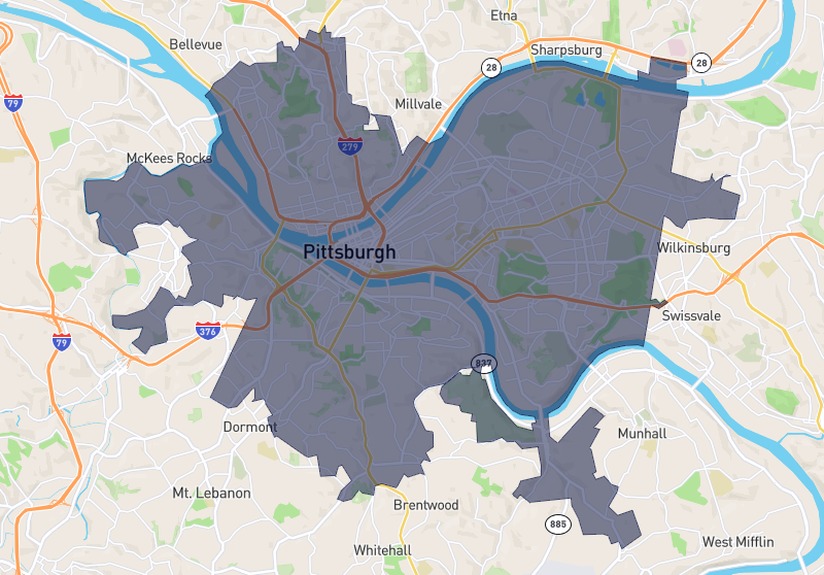
| Pittsburgh (Pittsburgh School District) | 4.00% | 5.00% | |
| Pittsburgh (Baldwin-Whitehall School District) | 3.50% | 4.50% | |
| Upper St. Clair Twp. | 1.50% | 2.50% | |
| West Deer Twp. | 1.50% | 2.50% | |
| Whitehall Boro | 1.25% | 2.25% | |
| Beaver | Georgetown Boro | 0.50% | 1.50% |
| Hookstown Boro | 0.50% | 1.50% | |
| Centre | Ferguson Twp. | 1.75% | 2.75% |
| State College Borough | 2.00% | 3.00% | |
| Taylor Twp. | 0.50% | 1.50% | |
| Clinton | Colebrook Twp. | 0.50% | 1.50% |
| East Keating Twp. | 0.50% | 1.50% | |
| Erie | Edinboro Borough | 1.50% | 2.50% |
| Lackawanna | Scranton, City of | 2.70% | 3.70% |
| Luzerne | Pittston City | 2.25% | 3.25% |
| Kingston Boro | 1.50% | 2.50% | |
| Wilkes-Barre, City of | 2.50% | 3.50% | |
| Mercer | Farrell, City of | 2.00% | 3.00% |
| Greenville Boro | 2.00% | 3.00% | |
| Hermitage, City of | 2.00% | 3.00% | |
| Sharon | 2.00% | 3.00% | |
| Somerset | Wellersburg Boro | 0.50% | 1.50% |
| Washington | Peters Township | 1.50% | 2.50% |
| Westmoreland | Greensburg, City of | 1.50% | 2.50% |
| Murrysville | 1.50% | 2.50% |
What Is the Pennsylvania Real Estate Transfer Tax?
When a home sells in Pennsylvania, both the buyer and the seller pay a transfer tax at closing — and it's one of those costs that surprises people every single time they see it on the settlement sheet. This is a significant portion of closings costs when buying or selling a home in Pittsburgh.
The standard rate is 2% of the sale price, split evenly: 1% goes to the state, and 1% goes to the local municipality. On a $300,000 home, that's $3,000 total — $1,500 from each side.
Simple enough. Except when it isn't.
Which Side Pays What?
By default, buyer and seller each pay 1%. That split is customary, not legally required. Which means it's negotiable — and smart buyers and sellers use that flexibility to their advantage.
If you're a buyer trying to win in a competitive market, offering to cover the seller's share of transfer tax is a way to make your offer more attractive without raising your purchase price. The seller nets the same amount either way — but you've reduced their out-of-pocket at closing, which matters.
If you're a buyer who's cash-strapped at closing, you can ask the seller to cover both sides. Here's why this matters more than it might seem: transfer tax is classified differently than seller concessions (sellers assist). This is a meaningful distinction for buyers whose loan type caps how much the seller can contribute toward closing costs.
FHA loans, for example, cap seller concessions at 6% of the purchase price. VA loans cap them at 4%. If you're bumping up against those limits but still need help covering closing costs, having the seller absorb the full transfer tax — paid outside of seller concessions — can give you breathing room without violating loan guidelines.
Talk to your lender before assuming you've maxed out seller help. You may have more options than you think.
Why Do Some Municipalities Charge Higher Transfer Taxes?
Pennsylvania's state transfer tax 1% is fixed. The local share is where it gets variable. Pennsylvania State law allows municipalities to set their own local transfer tax rate. Most stick to 1%. Some charge more.
In Allegheny County, the range runs from 1.25% locally (Whitehall Borough) all the way up to 4% locally (Pittsburgh, within the Pittsburgh School District) — which pushes the total transfer tax to 5% on a Pittsburgh city sale. On a $350,000 home in the city, that's $17,500 in transfer tax. That's not a rounding error.
Outside Allegheny County, other deviations exist across Pennsylvania. Scranton charges 3.7% total. Wilkes-Barre hits 3.5%. Pittston City reaches 3.25%. A handful of municipalities in Beaver, Clinton, and Somerset counties actually charge less than the standard 1% local rate, bringing their total below 2%.
City Of Pittsburgh Transfer Tax Warnings: What You Need To Know
The City of Pittsburgh as one of the highest real estate transfer taxes in the country, and many buyers are drawn to home in the city limits because they tend to have more affordable prices and seemingly lower taxes. There are caveats to be aware of:
- Buying in the City Of Pittsburgh increases the home price by 1.5% when factoring transfer taxes.
- A $300K Home In Crafton would cost $4,500 more in the city limits.
- The City of Pittsburgh's property taxes may be slightly lower than most Pittsburgh suburbs, but the City local income tax is 3% vs. 1% in most other municipalities which means if you make $100K per year, you're paying $2,000 more per year in income taxes.
If you're a lower income individual, then the you might benefit in the CIty over a suburb - but if you're key decision to buy a home in Brookline vs. Bellevue is saving a few thousand on taxes, you might need to rethink this.
You'll Need These Funds To Close
How Transfer Taxes Factor Into Calculating Closing Costs
Transfer tax is one of the largest line items at closing after the down payment and lender fees — and it's one of the easiest to underestimate when you're shopping in a higher-rate municipality. Worse, many agents fail to disclose the correct transfer tax which is why it is important to ensure you interview your agent before working with them. The last thing you want is two days before closing to find out you need another 1% or 2% of the purchase price in cash to close, which could thousands of dollars you may not have. You may not have even tried to purchase the home had you been informed. At the Knox Team, we cover transfer taxes and high transfer tax areas in our initial consultation to mitigate even looking in areas that may be unaffordable for buyers, or to have a great pricing strategy with out sellers to avoid deals dying at the closing table.
If you're buying or selling in McKeesport, Penn Hills, or Mt. Oliver Borough, you're looking at 3% total instead of 2%. On a $250,000 sale, that's an extra $2,500 above what you'd pay in most of Allegheny County. In Pittsburgh proper, within the Pittsburgh School District, that difference is even more significant.
The table above covers every known Pennsylvania deviation from the standard 2% — organized by county and searchable by municipality so you know exactly what to expect before you're sitting at a closing table wondering where that number came from.


Expert Guidance, From The Start.
Let's Talk!
The Right Agent Brings This Up Before You're Sitting At The Closing Table.
Your Agent Should Already Know This. So Should You. Knox Knows the numbers. You should too before you sign anything. Click to schedule a no pressure, no obligation today.
YOUR QUESTIONS
Frequently Asked Questions
Transfer tax is a fee charged every time a property changes hands in Pennsylvania. It's calculated as a percentage of the sale price and collected at closing. The standard rate is 2% of the sale price — 1% goes to the state and 1% goes to the local municipality where the property is located.
Transfer taxes vary by municipality and City, but all include the 1% Pennsylvania State portion of the transfer tax. Most localities are 2%. View our table to see if a specific area has a deviation that is higher.
By default, buyer and seller each pay half — 1% apiece. But that split is customary, not legally required, which means it's negotiable. A buyer can offer to cover the seller's share to make their offer more competitive. A cash-strapped buyer can ask the seller to cover both sides. Importantly, transfer tax is classified separately from seller concessions, so it doesn't count against FHA, VA, or conventional loan seller concession caps — giving buyers more flexibility than most people realize.
Pittsburgh has one of the highest transfer tax rates in Pennsylvania, and the rate depends on which school district the property falls in. In the Pittsburgh School District, the total transfer tax is 5.0% — 4% local plus 1% state. In the Baldwin-Whitehall School District portion of Pittsburgh, the total is 4.5% — 3.5% local plus 1% state. On a $350,000 home in the Pittsburgh School District, that's $17,500 in transfer tax at closing.
The total transfer tax in Bethel Park is 2.5% — a 1.5% local rate plus 1% to the state. By default this is split evenly, with each side paying 1.25%, though the split can be negotiated.
The total transfer tax in Mt. Lebanon is 2.5% — a 1.5% local rate plus 1% to the state. By default this is split evenly, with each side paying 1.25%, though the split can be negotiated.
The total transfer tax in Upper St. Clair is 2.5% — a 1.5% local rate plus 1% to the state. By default this is split evenly, with each side paying 1.25%, though the split can be negotiated.